
Wingspan, according to the people who played it
Wingspan wins near-universal praise for its components and the way its bird theme makes the engine intuitive. The disagreement runs deeper: five reviewers split on luck, whether parallel play without direct interaction is satisfying or empty, and whether late-game scoring converges too reliably on one path.
This synthesis draws on five independent written reviews, all based on hands-on play. The Almanac has not play-tested Wingspan. Every observation is attributed to the reviewer who made it.
Wingspan was designed by Elizabeth Hargrave and published by Stonemaier Games. It plays 1–5 players with a publisher-stated runtime of 40–70 minutes. The 2019 Kennerspiel des Jahres — the German jury’s award for games with more complexity than the main Spiel des Jahres candidate — recognised it against a field of established competitors. The game has since gone through multiple print runs and generated four expansions, including a standalone Asia variant.
What reviewers agree on
Every source praises the components without reservation. The 170 unique bird cards each carry an accurate species illustration and a scientific fact that connects directly to how that bird’s ability works in the game. Logan Giannini at Meeple Mountain calls it “the most ambitiously-produced game I have ever seen.” The birdfeeder dice tower — a wooden structure that randomises food tokens — is consistently praised as a piece of equipment that earns its table space rather than performing as a novelty.
The teach is short and the reason for that is specific. Giannini identifies it directly: “the game quickly proves more intuitive than many of similar predecessors thanks to its theme.” A bird that lives in flocks lays many eggs; one that hunts from perches takes prey from other habitats. The thematic mapping between species behaviour and card mechanics means players understand why a card does what it does, which reduces mid-teach confusion that equivalent mechanical games produce.
Four rounds with a declining action budget — each round gives one fewer action than the previous — creates an automatic pacing structure. Brian Biewer at Board Game Quest notes the practical result: “even four player games can be completed in an hour or less.” For a card-driven tableau game with 170 unique cards and five scoring categories, that is a reliable performance.
Where they disagree
Overall verdict. Brandon Kempf at The Opinionated Gamers played five times and recorded a “neutral” rating, explaining that the game is “really just ‘fine’” despite recognising its craft. Wade Monnig at There Will Be Games gave 3.5 out of 5 — a game he would keep but not one that offers enough for serious strategic engagement. Biewer at Board Game Quest gave 4.5 stars; the reviewer at Tabletop Mom rated it 7.5/10 after years of play with family and friends; Giannini at Meeple Mountain praised it substantially. The range is a real difference, not a scoring convention.
Luck in card draws and dice. This is the sharpest dividing line in the evidence. Monnig’s central criticism is that card draws and dice results determine the session’s outcome more reliably than the choices players make around them. He paraphrases the consistent table feedback as “‘I didn’t get…’” — players describing their session through what they failed to draw rather than through decisions they made. Tabletop Mom makes the same observation directly: “I’ve struggled to get my engine running due to poor luck of the draw.” Giannini acknowledges “failed gambits through no player fault.” Biewer and Kempf recognise the luck; neither finds it as damaging.
Player interaction. Kempf is the most specific: the experience is “you maximizing your score on your player board,” with few mechanisms that require or reward adapting to other players’ actions in real time. Giannini implies the same observation from a different angle, noting that “tracking opponent scores is challenging, making position assessment nearly impossible during play” — if reading your opponent’s position is impractical, adjusting to it is equally impractical. Biewer and Tabletop Mom describe the same parallel-building structure and find it satisfying. The table reading the same sessions differently is not a contradiction: some players find independent construction absorbing; others find it hollow.
Scoring convergence. Monnig identifies a specific structural problem: end-of-round goals heavily favour egg collection, pushing all players toward the same scoring path as the game matures. Tabletop Mom independently describes “an almost-inevitable egg-laying rush” in the final round. If this is accurate — and two reviewers with different access histories reach the same conclusion — it represents a real narrowing of the strategic variety visible in the card spread.
Why the disagreement exists
The divergence on overall verdict tracks two separate preferences: tolerance for randomness in competitive scoring games, and whether parallel construction without a direct contest feels like satisfying solo concentration or like a missed opportunity.
Monnig and Kempf both want more from the player-versus-player layer. They acknowledge the mechanical competence and exceptional production; what they find insufficient is the consequence of sharing a table without sharing contested space. Players who find the tableau puzzle engaging in itself — without requiring that an opponent’s success cost them something — report a different experience of the same sessions. Biewer’s enthusiasm and Kempf’s neutrality are not accounts of different games. They are descriptions of the same mechanism from players who weight interaction differently.
The luck criticism reflects a genuine variance in Wingspan’s card economy. The parallel play structure makes luck more visible: players at the same table but operating in separate spaces can directly observe when one person’s draw enabled something another player’s did not. In games with direct contests, luck is partially obscured by player-versus-player decisions. In Wingspan, it is more exposed.
The egg-dominance observation is a strategic rather than a preference critique. If Monnig and Tabletop Mom are independently accurate that the late-game converges on eggs, the stated variety in the 170 cards is narrower in practice than it appears. Reviewers who did not identify this criticism either had fewer sessions or experienced less convergence — neither the evidence nor the current source pool resolves whether this is a universal structural feature or a session-count artefact.
Who it suits, and who should skip it
Wingspan is a strong choice for anyone entering the hobby from a non-gaming background who is drawn by the bird theme and needs a reliable teach that requires no arcane vocabulary. The component quality is persuasive before the first card is drawn, which matters for groups who might not immediately commit to a mechanism.
It suits families with players around 10 and up. The scoring — five categories requiring calculation at the end — benefits from being walked through before the first session, but turn actions are quick and legible. Tabletop Mom’s multi-year family play is the most direct evidence for this.
It suits players who find parallel engine-building satisfying in itself. If accumulating connections across a growing tableau is engaging without requiring the person across the table to suffer for it, Wingspan delivers that consistently inside the publisher-stated runtime.
It is probably not the right purchase for players who want to contest space, block strategies, or adapt directly to opponent behaviour in real time. It is less suitable for experienced hobby gamers who find high luck-to-skill ratios frustrating in competitive contexts, or who expect late-game scoring to open strategic options rather than converge. Groups where one player substantially outperforms others in tableau-building games may find the score gap larger than expected, with less mechanism for trailing players to recover.
What to compare next
Cascadia is the nearest nature-themed alternative. It is lighter, faster, and has no mechanism for interfering with other players’ arrangements. For groups where even Wingspan’s indirect tile-blocking would create friction, Cascadia removes it entirely.
Everdell occupies a similar weight class with worker placement added. Workers can displace other players and create genuinely contested spaces. For groups who find Wingspan’s parallel play underwhelming, Everdell adds interaction while keeping the tableau-building structure and a comparable teach.
Lost Ruins of Arnak combines deckbuilding with worker placement and involves direct competition through limited expedition spaces. It teaches in a similar session length and suits groups who found Wingspan engaging and want more adversarial texture in the mid-game.
Wyrmspan is Wingspan’s direct successor from Stonemaier Games, replacing birds with dragons and redesigning the action structure to give players more flexibility in how they pursue each scoring path. For players who liked the engine concept but found the card-luck dependency frustrating, it is the most relevant next step.
Wingspan’s 170 bird cards and multiple expansion decks generate card-effect and timing questions across most sessions, and those questions arise more often — not less — as players encounter more of the card pool. For in-session rulings during a live game, Rodney at /rules answers from the reviewed rulebook for supported games.
The games
Every entry links to its full catalogue record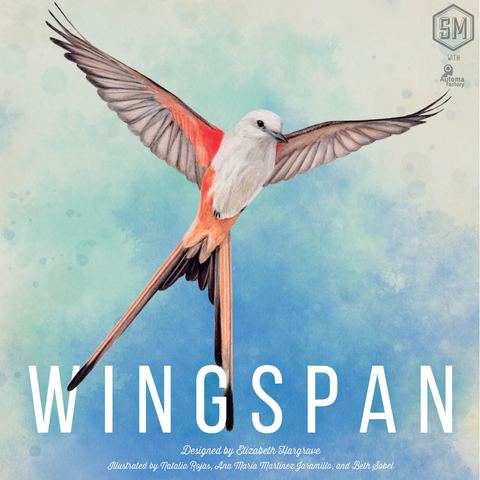
Is Wingspan worth buying?
Five reviewers converge on Wingspan's components and teach, but split on luck, parallel-play interaction, and whether egg scoring dominates late.
Search the full catalogueReview evidence
Accessed and checked individually- Official sourceStonemaier Games: Wingspan — Official Page
Accessed 3 September 2026
Elizabeth Hargrave, designer. Stonemaier Games, publisher. 1–5 players, 40–70 minutes per publisher. 2019 Kennerspiel des Jahres. 170 unique bird cards. Multiple expansions available. Official source for edition and rules facts; does not count toward the five reviewers.
- Written reviewMeeple Mountain: Wingspan Game Review
Accessed 3 September 2026 · Independent group: Meeple Mountain · Product access: supplied by publisher kept · affiliate links
Logan Giannini. Free review copy; Amazon affiliate links. Praises production quality — "the most ambitiously-produced game I have ever seen" — and the intuitive link between theme and mechanics. Criticises reactive gameplay, difficulty assessing opponents, and card luck leading to failed gambits.
- Written reviewBoard Game Quest: Wingspan Review
Accessed 3 September 2026 · Independent group: Board Game Quest · Product access: supplied by publisher kept · affiliate links
Brian Biewer. Review copy from publisher; Amazon affiliate links. 4.5 stars. One of his most played games of 2018. Praises engine building, component quality, and reliable play time — notes four-player sessions run under an hour. Criticises high card-draw luck and the absence of a mechanism to clear face-up bird cards.
- Written reviewTabletop Mom: Wingspan — Board Game Review
Accessed 3 September 2026 · Independent group: Tabletop Mom · Product access: supplied by publisher kept · no commercial relationship stated
Review copy from publisher; reviewer states opinions are their own. 7.5/10. Multiple plays over several years with family and friends. Praises the accessible engine structure and clean visual design. Criticises luck of the draw, predictable end-round egg rush, and new-player confusion about egg costs.
- Written reviewThere Will Be Games: From Tip to Tip-Taking Measure of Wingspan: A Wingspan Board Game Review
Accessed 3 September 2026 · Independent group: There Will Be Games · Product access: purchased · disclosure not found
Wade Monnig. Game purchased. 3.5/5. Most critical. Argues card-draw and dice luck dominates outcomes over decisions; paraphrases table feedback as 'I didn't get...' Identifies egg scoring as outperforming alternatives and end-round goals as reinforcing that bias. No commercial disclosure found.
- Written reviewThe Opinionated Gamers: Wingspan
Accessed 3 September 2026 · Independent group: The Opinionated Gamers · Product access: not stated · disclosure not found
Brandon Kempf. Five plays. Neutral verdict — the game is "really just 'fine'" despite its craft. Describes the core experience as "you maximizing your score on your player board" with few ways to force opponents to adapt. Notes unreliable pink powers and card-digging frustration. No disclosure found.
More guides
- Buying guideBoard games past the gateway stageSix board games for groups that have enjoyed Ticket to Ride or Catan and want more strategic depth. Player counts, teach times, and fit notes for each.
- ReviewsBlood Rage, according to the people who played itFive reviewers praise Blood Rage's miniatures and card-driven combat, but split on expansion pricing, a figurine design, and whether one card distorts the game.
- Table cultureThe rule you have been getting wrongHow common rule errors stay hidden in popular games, why they rarely surface until someone checks, and what to do when you find one mid-session.