
Blood Rage, according to the people who played it
Blood Rage earns near-universal praise for its miniature quality and the counterintuitive pleasure of winning by dying. The disagreement is narrower but real — reviewers divide on a female miniature's design, the aggressive simultaneous expansion release, and whether one card dominates late play.
This synthesis draws on five independent written reviews, all based on hands-on play. The Almanac has not play-tested Blood Rage. Every observation is attributed to the reviewer who made it.
Blood Rage was designed by Eric M. Lang and published by CMON in 2015. It plays 2–4 players, with a publisher-stated run time of 60–90 minutes. The game funded through Kickstarter, raising over $900,000 from backers. A fifth-player expansion and several clan expansions are available separately. The base game was recommended for the 2016 Kennerspiel des Jahres and nominated for multiple Golden Geek Awards including Board Game of the Year and Best Thematic Game.
What reviewers agree on
Every source praises the miniatures without reservation. Jesse Fletcher at Meeple Mountain states the figures “look fantastic, even without taking the time to paint” and describes it as “a game that I’ve played over and over again.” Owen Duffy at Tabletop Gaming praises “the exquisite quality of its multitude of plastic miniatures” and the game “manages to be simultaneously strategic, bloody and beautiful.” The review on S. Craig Zahler’s site — which carries the most sceptical overall score in the source pool at 7.25/10 — still leads with “excellent miniatures and terrific art.” Katarzyna Satława at Ostatnia Tawerna rates production quality 9/10. Wyatt Krause at Sprites and Dice, who purchased his copy, calls it “a greatly improved wargame, made fun and accessible for many different approaches and playstyles.”
The game’s structural innovation draws consistent acknowledgement. Blood Rage uses card-based combat rather than dice: both players secretly select a battle card from their drafted hand, and the higher value wins. This replaces the randomness of a dice roll with the strategic tension of a committed secret choice. Krause identifies the draft as the game’s key preparation layer — what you select determines what options you can play later. Fletcher praises the “meaningful synergies between cards” that the drafting system enables.
All five sources engage with the game’s central counterintuitive mechanic: dying is often a planned path to victory. Figures destroyed by Ragnarok — which consumes a province at the end of each round — score glory for the losing clan. Figures killed in combat can be resurrected in the following Age. Losing territory and pieces is therefore not simple failure; it is frequently a deliberate strategy for earning points and rebuilding strength. Duffy notes the result is a game that “takes the essence of a sprawling, three-hour-plus strategy title and condenses it” into the play time. The Zahler site describes the self-sacrifice element as a shift in player goals that makes each session genuinely different.
Where they disagree
Female miniature design. Duffy at Tabletop Gaming identifies what the other four reviewers either praise or do not address: “one of the clans included sports the kind of ridiculous chainmail bikini battlewear that was already an embarrassment when it appeared in the roleplaying games of the 1980s,” describing it as “likely to alienate more players.” Fletcher, Krause, Satława and the Zahler site treat components positively or in aggregate, without raising this point. This is not an absence of a viewpoint: it is an explicit editorial observation that the other reviews do not engage with. Whether the design is a meaningful concern or an acceptable tradition depends on who is reading the review.
Expansion release strategy. Duffy alone raises the business practice: CMON released multiple clan expansions simultaneously with the base game. He frames this as a question about whether the base game — priced at £65 at the time of the review — represents a complete product or an entry point into further spending. No other source addresses this point. It is a purchasing-decision concern rather than a gameplay critique.
Card balance. The Zahler site review criticises one card specifically: the re-pillaging card “massively warped the game in the card user’s favor” in every session the reviewer recalls. No other source identifies this card by name, though Krause observes that sessions occasionally produced large score gaps in multiplayer — an outcome consistent with high card variance. Whether the re-pillaging card is uniquely imbalanced or simply the most visible example of card-driven variance that every card-drafted game carries is not resolved by the available source pool.
Price and accessibility. Krause flags the $80 entry price as “a large hit to the wallet” for a component-heavy game. Satława notes that complete beginners may struggle to identify optimal decisions and that strategic experience helps. Duffy, by contrast, describes the game as accessible to both “experienced strategy gamers and more casual players just dipping their toe into more complex offerings” — a broader claim. The contradiction is likely genuine: the game’s action structure is quick to learn, but the drafting decisions that determine competitive outcomes require understanding the card pool.
Why the disagreement exists
The female miniature criticism is the clearest case of reviewers dividing on evaluation criteria rather than game experience. Duffy applies a representation standard to component design; the other four sources either did not consider the question or chose not to raise it. A reader whose purchase decision includes that criterion should weight Duffy’s observation accordingly.
The expansion criticism reflects a purchasing philosophy rather than gameplay. CMON’s practice of releasing expansions at launch is consistent across several of their larger titles and is a commercial choice that affects how a buyer budgets for the game. The base game’s internal balance and completeness as a standalone product receive positive treatment from all five sources.
The card balance disagreement is specific and worth taking at face value. Krause’s indirect observation about score gaps and the Zahler site’s specific identification of the re-pillaging card point to the same underlying question: how much does any single drafted card change the session outcome? A game built around card drafting and secret combat selection will have cards of uneven power, and the re-pillaging card may sit at the high end of that range.
The accessibility gap between Duffy and Satława is most likely explained by audience and table context. Duffy writes for a general games readership and frames accessibility in terms of rules clarity and session length. Satława writes for a hobby gaming readership and frames it in terms of strategic optimization. Both observations may accurately describe different kinds of tables encountering the game.
Who it suits, and who should skip it
Blood Rage is a strong choice for groups that enjoy direct conflict, area control, and strategic competition with an assertive table tone. The multiple victory paths — Ragnarok deaths, combat wins, quest completion, upgrade combinations — mean players can pursue genuinely different strategies across sessions. Krause’s 12-session count across different groups is the clearest evidence of sustained playability.
It suits groups that value physical production quality as an intrinsic part of the experience. The component quality is distinctive within the area control category, and the table presence is consistent across all five sources. Fletcher’s sustained enthusiasm across many plays suggests the game retains interest after the initial novelty.
The drafting phase requires real attention. Players who approach the first draft without understanding which card combinations matter to their intended strategy will find the action phase less coherent. Satława’s caution about beginners is relevant for groups where one player will be teaching others with no area control background — the game is not self-teaching in the way shorter gateway games tend to be.
Groups that are conflict-averse, where direct attacks, clan elimination, and aggressive territorial control create friction rather than excitement, should look elsewhere. The Ragnarok and combat systems are designed around confrontation; the game does not provide a competitive cooperative or low-conflict variant.
Buyers for whom Duffy’s female miniature observation resonates should factor it into the decision. It is one clan among several, but the observation is specific and the concern is not unfounded.
What to compare next
Inis (2016, Matagot) replaces the Norse setting with Celtic mythology and reduces direct conflict. Area control matters, but the game’s victory conditions — each involving reaching a threshold while opponents fail to object — create a different kind of tension than Blood Rage’s combat. For groups who found the cardboard-and-miniature conflict appealing but want less direct elimination, Inis is the nearest equivalent.
Rising Sun (2018, CMON) is Eric Lang’s follow-up, drawing on Japanese mythology. It adds a structured alliance and betrayal layer, where alliances are formally proposed and betrayed, and assigns seasonal bonuses by clan through negotiation. The production standard matches Blood Rage’s. For players who found the combat and drafting engaging and want more political texture, Rising Sun is the most direct successor.
Root (Leder Games, 2018) is a conflict-driven asymmetric area control game where each player’s faction operates under fundamentally different rules. It is less miniature-heavy and more abstract, but the underlying preference it satisfies — area control with genuinely different goals and paths to victory — overlaps with what Blood Rage’s sources consistently praise.
Blood Rage’s card interactions produce regular in-session questions as players encounter new combinations of drafted abilities, combat cards, and monster powers across different play groups. For in-session rulings during a live game, Rodney at /rules answers from the reviewed rulebook for supported games.
The games
Every entry links to its full catalogue record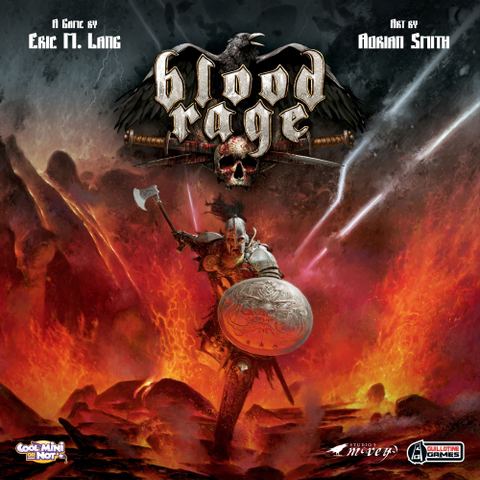
Is Blood Rage worth buying?
Five reviewers praise Blood Rage's miniatures and card-driven combat, but split on expansion pricing, a figurine design, and whether one card distorts the game.
Search the full catalogueReview evidence
Accessed and checked individually- Written reviewSprites and Dice: Blood Rage Review
Accessed 1 October 2026 · Independent group: Sprites and Dice · Product access: purchased · no commercial relationship stated
Wyatt Krause. Copy purchased; no commercial relationship stated. Over 12 plays with different groups. Praises multiple victory paths, card-based combat, accessible design. Criticises $80 entry price and storage post-opening. Notes occasional large score gaps in multiplayer.
- Written reviewMeeple Mountain: Games We Love — Blood Rage
Accessed 1 October 2026 · Independent group: Meeple Mountain · Product access: not stated · affiliate links
Jesse Fletcher. Amazon affiliate links; no explicit review-copy disclosure. Many plays ('a game I've played over and over again'). No criticisms stated. Praises miniature quality, card-drafting synergies, strategic depth across multiple victory paths.
- Written reviewTabletop Gaming: Blood Rage Review
Accessed 1 October 2026 · Independent group: Tabletop Gaming · Product access: not stated · affiliate links
Owen Duffy. Tabletop Gaming Magazine. Affiliate link disclosure. Praises miniature quality and American/European design blend. Criticises female miniature design ('likely to alienate more players') and CMON releasing multiple expansions simultaneously with the base game.
- Written reviewS. Craig Zahler: Blood Rage (2017 Review)
Accessed 1 October 2026 · Independent group: S. Craig Zahler · Product access: not stated · disclosure not found
Author attributed to Dallas Sonnier; site is S. Craig Zahler's personal blog. No commercial disclosure. 7.25/10. Multiple plays. Praises miniature quality and artwork. Criticises counterintuitive card naming and the re-pillaging card as disproportionately powerful.
Accessed 1 October 2026 · Independent group: Ostatnia Tawerna · Product access: not stated · disclosure not found
Katarzyna Satława. Polish board game publication. No commercial disclosure. Overall 8.2/10 (production 9/10, playability 8.5/10). Multiple plays; recent sessions exceeded earlier impressions. Notes confusion in resurrection mechanics and that beginners may struggle with optimal strategy.
More guides
- Buying guideBoard games past the gateway stageSix board games for groups that have enjoyed Ticket to Ride or Catan and want more strategic depth. Player counts, teach times, and fit notes for each.
- Table cultureThe rule you have been getting wrongHow common rule errors stay hidden in popular games, why they rarely surface until someone checks, and what to do when you find one mid-session.
- Table cultureGames you will definitely play somedayThe aspirational heavy, the wrong-player-count game, the impulse buy — a taxonomy of unplayed board games and what the ratio tells you.