
Ticket to Ride, according to the people who played it
The original gateway train game is 22 years old and still selling. Five independent reviewers converge on the teach time and the lasting theme, but split on replayability, the two-player game and whether the card-draw luck is a feature or a frustration.
Ticket to Ride is worth buying for most groups — with one clear condition. At three to five players, including people who rarely play board games, the game delivers exactly what its reputation suggests: a ten-minute teach, a reliable 45-to-60-minute session and a finish that tightens before the end. At two players, the reviewers are unanimous: there are better options.
What reviewers agree on
The teach is the observation that reviewers return to first. Meeple Mountain’s Kevin Brantley writes that the rules could fit on a train ticket and the game can be taught in under five minutes. Board Game Review UK calls it one of the best entry-level games available, rating it 4.7 out of 5 and noting that its accessibility for players not accustomed to modern board gaming means almost everyone engages from the first session.
Component quality earns consistent praise. Ronny Alexander at CoopBoardGames notes 225 custom-moulded plastic train cars that exceed the quality of typical mass-market game components. Board Game Review UK reaches the same conclusion after an independent purchase, and it is among the points every reviewer raises without prompting.
The session structure also holds across different descriptions. Routes build throughout the game, and the final turns — when every player is protecting or completing their network — produce real tension. Rich Stangle at Game Night Blog calls this one of the strongest finishes in the family-game category. No reviewer describes a session that drags or trails off.
The consensus across five reviewers is that the 22-year-old reputation is grounded in something real. Brantley notes the game has sold over 18 million copies worldwide; the reviews explain why, and none of them disagrees with the underlying achievement.
Where they disagree
Replayability after many plays is the clearest split. Josh at Board Game Reviews by Josh gives the game 7 out of 10 and identifies low replayability as its central weakness: once players have found efficient strategies, sessions become predictable. CoopBoardGames raises the same concern, noting that decision-making can feel limited once the core patterns are familiar.
Stangle and Brantley land on the opposite side. Stangle describes the game as enduring across repeated family plays; Brantley notes that the variable destination tickets and the human element across different player groups keep returning sessions interesting.
The two-player game is not quite a disagreement — it is a consistent limitation. Board Game Review UK says directly that there are better two-player games. CoopBoardGames identifies the same issue: two-player sessions lack the dynamic tension that contested routes create at higher counts. Stangle recommends four to five players as the best count. No reviewer makes a case for the two-player game on its own terms.
How much the card-draw luck matters divides reviewers along experience lines. CoopBoardGames treats the luck element as a limitation: “card draw luck sometimes outweighs strategic decision-making.” Meeple Mountain frames the same element as what makes the game work across a wide audience — what plays as a gentle lesson in strategy for a new player scales to a knife fight over rail lines for an experienced one. Josh’s critique of the limited decision space points in a similar direction to CoopBoardGames.
Why the reviews diverge
Most of the disagreement traces back to player count and experience level, and both variables genuinely change the game being played.
The blocking mechanic depends on competition for limited routes. At three to five players, contested rail lines create real decisions about when to claim a route versus continue drawing cards. At two, routes are rarely contested and the tension is diluted. Reviewers who primarily describe the three-to-five-player experience describe a different session than reviewers who tested smaller counts.
Experience level does the same thing to the card-draw luck. A new player finds the set-collection element engaging because drawing the right cards feels like progress. An experienced player, who can read the board, may find that card availability — not decisions — determines the result. The luck ceiling is a feature for mixed-skill tables and a ceiling for experienced-only ones.
Reviewers writing primarily for families and gateway audiences are accurately describing a different session than reviewers oriented toward hobby gaming. The game optimises for the former.
Who it suits
Groups that include non-gamers or occasional players who want a session under 60 minutes. Families with children aged 8 and above who want a clear theme and minimal explanation time. Social gatherings at three to five players where the goal is shared engagement rather than strategic depth. People buying a first or second board game who want something that works reliably across a wide range of participants.
Who should skip it
Two-player households looking for the strongest game in that format. Regular hobby-gaming groups where all players are experienced and prefer decisions with more strategic depth and less reliance on draws. Groups who have already mastered Ticket to Ride and want something that rewards more complex planning.
What to compare next
Ticket to Ride: Europe (2005) adds route-blocking stations and ferry crossings using the same core mechanics. Reviewers broadly regard it as the more mechanically complete version of the system, and it suits groups who enjoy the original and want one additional layer of decision-making without switching to a different game.
Azul covers a similar gateway role: quick teach, 45-minute sessions, strong components. The mechanic is abstract tile-drafting rather than route-building, with no card-draw luck element. It suits groups who enjoyed Ticket to Ride but want a tighter decision space and a shorter box.
Codenames is a stronger two-player option — particularly the Duet variant — and teaches in the same few minutes as Ticket to Ride. The word-association mechanic means each session is genuinely different without the route-building framework.
The games
Every entry links to its full catalogue record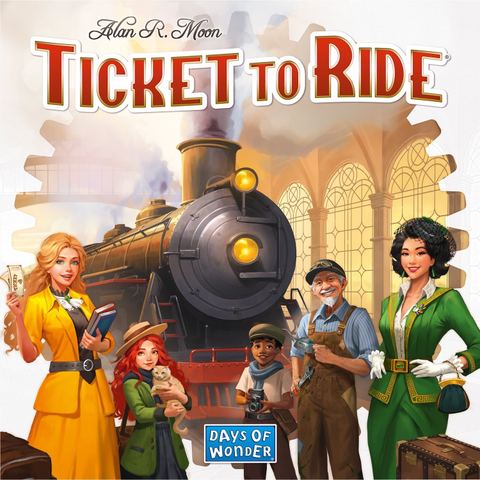
Is Ticket to Ride worth buying?
Five reviewers converge on Ticket to Ride's quick teach, but split on two-player tension, replayability and how much card-draw luck shapes the result.
Search the full catalogueReview evidence
Accessed and checked individually- Official sourceDays of Wonder: Ticket to Ride — Official Product Page
Accessed 4 September 2026
Official publisher source. Edition facts: designer Alan R. Moon, Days of Wonder, 2–5 players, 30–60 minutes, age 8+. Does not count toward the five independent reviewer sources.
- Written reviewMeeple Mountain: Ticket to Ride (Refresh) Game Review
Accessed 4 September 2026 · Independent group: Meeple Mountain · Product access: supplied by publisher kept · affiliate links
Kevin Brantley, September 2025. Review of the 2025 Refresh edition; reviewer confirms the mechanics are unchanged from the original 2004 game. Free copy received from publisher in exchange for an honest review.
- Written reviewBoard Game Review: Ticket To Ride Review
Accessed 4 September 2026 · Independent group: Board Game Review · Product access: purchased · affiliate links
Anonymous reviewer, January 2020. Game purchased independently; reviewer states this has not affected the review. Amazon and retailer affiliate links present.
- Written reviewBoard Game Reviews by Josh: Ticket to Ride Review
Accessed 4 September 2026 · Independent group: Board Game Reviews by Josh · Product access: not stated · affiliate links
Josh, November 2010. Product access not stated. Amazon Associates affiliate links present.
- Written reviewGame Night Blog: Ticket to Ride — Family Game Review
Accessed 4 September 2026 · Independent group: Game Night Blog · Product access: not stated · disclosure not found
Rich Stangle, February 2019. Product access not stated. No commercial disclosures found.
- Written reviewCoopBoardGames: Ticket To Ride Board Game Review
Accessed 4 September 2026 · Independent group: CoopBoardGames · Product access: not stated · disclosure not found
Ronny Alexander, November 2025. Product access not stated. No commercial disclosures found.
More guides
- Buying guideBoard games past the gateway stageSix board games for groups that have enjoyed Ticket to Ride or Catan and want more strategic depth. Player counts, teach times, and fit notes for each.
- ReviewsBlood Rage, according to the people who played itFive reviewers praise Blood Rage's miniatures and card-driven combat, but split on expansion pricing, a figurine design, and whether one card distorts the game.
- Table cultureThe rule you have been getting wrongHow common rule errors stay hidden in popular games, why they rarely surface until someone checks, and what to do when you find one mid-session.