
Azul, according to the people who played it
Azul won the 2018 Spiel des Jahres and earns near-universal praise for its components and quick teach. The split is subtler: every reviewer reads the player count differently, and one finds the abstract core unsatisfying even in a beautiful shell.
This synthesis draws on five independent written reviews, all based on hands-on play. The Almanac has not play-tested Azul. Every observation is attributed to the reviewer who made it.
Azul was designed by Michael Kiesling and published by Next Move (formerly Plan B Games). It plays 2–4 players, with an age 8 and up recommendation and an approximately 45-minute runtime from the publisher. The 2018 Spiel des Jahres jury awarded it Game of the Year, praising how much depth the designer hid inside what looks like a simple colour-selection mechanic.
What reviewers agree on
Every source praises the physical quality of the components without reservation. The resin tiles are chunky, satisfying to handle and make a distinct sound when drawn from the bag. David McMillan at Meeple Mountain describes practical advantages that are easy to underestimate: fast setup, fast teardown, and a play time he puts at 20 to 30 minutes. Luke Muench at The Cardboard Herald calls the game “elegant in function and hilarious fun in practice.”
The teach is consistently described as short. Players take all tiles of one colour from a factory display, place them on a matching pattern line on their personal board, then score points by completing rows and transferring tiles to the decorative wall grid. Tiles that do not fit go to the floor line and cost points. Most reviewers describe a functional teach in under ten minutes.
The strategic tension sits underneath that simplicity. What colour you take determines what is left for every other player. An optimal move for your own board may be a damaging one for your opponent’s, and vice versa. Ryan Gutowski at One Board Family describes the core interaction as “as much about getting the tiles you want as denying your opponents the tiles they need.” McMillan compares the opponent-reading required to the way chess demands thinking about what the other player is about to do.
Where they disagree
Overall verdict. Matt Thrower at There Will Be Games rated Azul 3 out of 5 and, across multiple sessions with different groups including his daughter, found a “dry, mechanical abstract feel” that persisted beneath the appealing aesthetics and satisfying components. The other four reviewers praised the game considerably more warmly. That is a real difference, not a scoring quirk.
Player count. Thrower preferred three players, finding that configuration more “friendly” because hate-drafting pressure is reduced when the tile pool is spread across more competitors. Gutowski particularly praised the two-player experience. McMillan found the game works well across all configurations from two to four. These are genuine observations, not contradictions: the drafting dynamic changes meaningfully at each player count, and each reviewer is accurately reporting a different table experience.
Younger players. Stephen Duetzmann at Engaged Family Gaming found through family play that the “seeming simplicity is deceptive” — younger players can be confused when their scores are lower than expected, because the floor-line penalty system requires anticipating overflows before they happen. Gutowski’s review notes that no reading is required but that scoring takes a game or two to click. The publisher’s age 8 guidance appears optimistic based on these observations.
First session versus sustained play. McMillan at Meeple Mountain explicitly reports disliking Azul after a poor first session, then substantially revising that view over subsequent plays. A single game can produce an unrepresentative result: the tile randomness and floor penalties hit harder when the underlying strategy has not yet been understood.
Why the disagreement exists
The sharpest disagreement — Thrower’s 3 out of 5 versus the other reviewers’ stronger endorsements — tracks preference for thematic engagement over abstract puzzle-solving. Thrower’s reservation is not about how the game works mechanically; it is about how the game feels to play over time for someone who may expect more than visual beauty and a clean decision-loop. Players who find the tile-placement puzzle rewarding in itself appear not to experience the limitation he identifies.
The player count disagreement has a mechanical explanation. At two players, every drafting choice is a direct contest with one opponent. At three, the field widens and individual decisions become less pointed. At four, chaos in the factory displays increases and the hate-drafting becomes harder to sustain deliberately. None of these modes is wrong; they suit different preferences and it matters which version of the game you are actually buying it for.
The age gap reflects a real asymmetry between what the rules require to begin playing and what the scoring system demands to play well. The penalty mechanism is easy to miss on first contact and discourages players before they understand what they did wrong.
Who it suits, and who should skip it
Azul is a strong choice for two adults who want a sharp, fast contest with meaningful decisions in under 40 minutes. It works as a family game for households with players around 10 and up, especially if the floor-line penalty system gets a clear walkthrough before the first session. It suits anyone who finds an abstract spatial puzzle satisfying in itself without needing a thematic wrapper to stay engaged.
It is probably not the right purchase for players who strongly prefer games where theme and mechanism feel integrated, who are buying it primarily for children younger than 9 or 10, or who find persistent blocking unpleasant. The blocking in Azul is lighter than in many heavier strategy games but it is constant: taking a colour specifically to deny it to another player is a legitimate and rewarded move, and the game does not pretend otherwise.
What to compare next
Ticket to Ride shares the quick teach and direct route-blocking, adds a readable travel theme, and plays longer. It is the more accessible choice for a group that prefers a theme and can tolerate ten or fifteen extra minutes.
Cascadia removes most direct conflict. Players draft terrain tiles and wildlife tokens without a mechanism for interfering with each other’s arrangements. It suits groups where Azul’s confrontational edge would produce friction.
7 Wonders Duel is a sharper two-player-only alternative with more mechanical complexity. It takes longer to teach but rewards the same investment in reading an opponent’s intentions across multiple rounds.
Sagrada uses dice-drafting in a similar aesthetic register. The adjacency constraints are different and the luck element is more prominent, but the tactile appeal and quick play time are comparable.
The games
Every entry links to its full catalogue record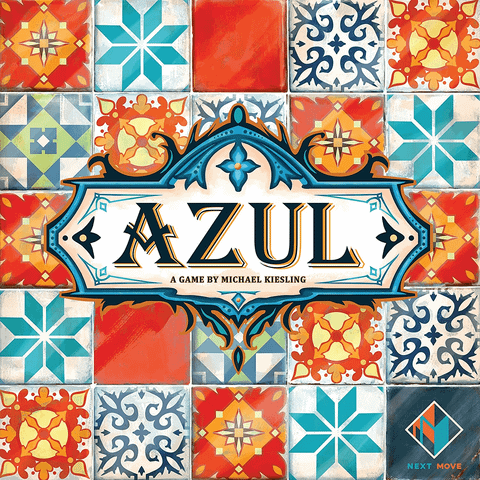
Is Azul worth buying?
Five reviewers converge on Azul's tiles and quick teach, but split on abstract appeal, player count and whether younger players will cope.
Search the full catalogueReview evidence
Accessed and checked individually- Award criteriaSpiel des Jahres: Azul — Awarded Games
Accessed 29 August 2026
Official facts. Michael Kiesling, publisher Next Move, 2–4 players, age 8+, approx. 45 min. SdJ 2018. Jury praised depth hidden inside a simple selection mechanic; sober functionality contrasts with aesthetic beauty. Does not count as a reviewer source.
- Written reviewMeeple Mountain: Azul Game Review
Accessed 29 August 2026 · Independent group: Meeple Mountain · Product access: not stated · affiliate links
David McMillan. Multiple plays; initial negative experience on first session before becoming a strong advocate. Notes quick setup and teardown, chess-like opponent-watching, brain-burning decisions. Amazon affiliate link present; no review copy or sponsor mentioned.
Accessed 29 August 2026 · Independent group: The Cardboard Herald · Product access: not stated · disclosure not found
Luke Muench. Played extensively including at Origins gaming convention. Calls it elegant in function and hilarious fun in practice. Notes a colour-blind accessibility gap without replacement tiles, and that components scatter when the table is bumped. No commercial disclosure found.
- Written reviewThere Will Be Games: Azul Board Game Review
Accessed 29 August 2026 · Independent group: There Will Be Games · Product access: not stated · disclosure not found
Matt Thrower. Multiple sessions including with his daughter and gaming group. Rated 3 out of 5. Praised component quality but found the dry, mechanical abstract feel persisted beneath appealing aesthetics. Preferred three players for reduced hate-drafting intensity. No commercial disclosure found.
- Written reviewOne Board Family: Review: Azul
Accessed 29 August 2026 · Independent group: One Board Family · Product access: not stated · affiliate links
Ryan Gutowski. Approximately two dozen plays across 2–4 players. Strong recommendation especially for families and gateway players. Notes no reading is required but scoring needs a game or two to click. Amazon affiliate link present; no review copy or sponsor mentioned.
- Written reviewEngaged Family Gaming: Family Board Game Review: Azul
Accessed 29 August 2026 · Independent group: Engaged Family Gaming · Product access: not stated · affiliate links
Stephen Duetzmann. Family play with children. The seeming simplicity is deceptive — younger players get frustrated by low scores when the floor-line penalty is not understood. Praised no-reading accessibility and visual appeal. Amazon affiliate link; no review copy mentioned.
More guides
- Buying guideBoard games past the gateway stageSix board games for groups that have enjoyed Ticket to Ride or Catan and want more strategic depth. Player counts, teach times, and fit notes for each.
- ReviewsBlood Rage, according to the people who played itFive reviewers praise Blood Rage's miniatures and card-driven combat, but split on expansion pricing, a figurine design, and whether one card distorts the game.
- Table cultureThe rule you have been getting wrongHow common rule errors stay hidden in popular games, why they rarely surface until someone checks, and what to do when you find one mid-session.