
7 Wonders, according to the people who played it
7 Wonders won the 2011 Kennerspiel des Jahres and plays seven people in 30 minutes. Five reviewers converge on its drafting speed and scalability; the disagreement is about interaction depth, the long-term replayability ceiling, and which version to start with.
Five independent hands-on reviewers converge on 7 Wonders’ central proposition: a card-drafting civilization game that plays three to seven people in about 30 minutes, with no one waiting while another player finishes a turn. The disagreement runs deeper — reviewers split on whether the simultaneous drafting format creates genuine interaction or keeps players largely in their own civilizations, whether the replayability holds across dozens of sessions or reveals structural limits, and whether the 14-year-old base game remains the right starting point given what has come since.
This synthesis draws on five hands-on written reviews and one official source. It does not represent Almanac play-testing.
What reviewers agree on
The simultaneous drafting format is the game’s defining feature and earns consistent praise from all five sources. Players select a card from their hand at the same moment, then pass their remaining hand to a neighbor. Tony Mastrangeli at Board Game Quest describes this as the standout quality: the mechanism scales from three to seven players without extending the play time, because adding players means a larger opening hand rather than more turns to wait through. FarmerLenny and Futurewolfie at Islay the Dragon call the result “nearly flawless execution” in terms of minimising downtime, giving the game a 9.0 out of 10.
Kurt Refling at Meeple Mountain writes from extensive experience teaching the game at a board game café — hundreds of plays across years of facilitated sessions. He confirms the teach time claim: the icon system creates a first-play friction, but the card types become readable after one round of each age. The 2020 new edition added a reference card that addresses the most consistent beginner complaint about unfamiliar symbols; Refling notes the improvement while pointing out that setup still carries overhead, particularly with expansions.
Multiple scoring paths attract consistent praise. Military (red cards), science (green cards), commercial trading (yellow), civic victory points (blue), wonder construction and guilds can each anchor a winning strategy. Board Game Reviews by Josh describes this as a functional strength: the game rarely feels solved from a single direction, and early sessions surface meaningfully different approaches. No reviewer disputes the variety.
The icon learning curve is the universal downside. Every reviewer names it explicitly. The system becomes elegant after internalization; before that point, it slows the first half of game one. The 2020 new edition partly addresses this, but reviewers writing before and after the update both name it as a barrier.
All five reviewers also agree that the 2-player variant, which introduces a dummy “ghost civilization” to maintain the pass-and-draft structure, is unsatisfying. Repos Production’s official product page lists 3–7 as the supported count. This consensus is consistent enough to treat as a clear buying signal: two-player households should look at 7 Wonders: Duel rather than the base game.
Where they disagree
Whether the game creates real interaction. Kurt Refling at Meeple Mountain calls 7 Wonders “a pretty solitary experience.” Beyond military comparison between neighbors and the occasional deliberate card denial, most decisions are made without direct reference to what other players are doing. This reading accurately describes the mechanical structure; the weight reviewers give it varies sharply.
Islay the Dragon and Board Game Reviews by Josh describe the same structure and arrive at different conclusions. Passing your hand after each selection means your discarded options become a neighbor’s options; strategic card denial — taking a card for its denial value rather than its own contribution — is a tactical layer available to experienced players. The resource trading system, where you pay neighbors for resources you cannot produce, creates a constant bilateral awareness of what adjacent players have built. These reviewers treat indirect interaction as real interaction. Meeple Mountain treats it as insufficient.
The disagreement maps to what a player expects from a multi-player game. Groups who want direct confrontation and blocking will experience 7 Wonders as Meeple Mountain describes. Groups who enjoy parallel problem-solving with environmental awareness will find the tension that Islay the Dragon is measuring.
Long-term replayability and when the ceiling appears. Board Game Quest gave 7 Wonders five stars in 2012 partly on high replay value. Board Game Reviews by Josh gave it an 8.5 and noted “limited decision variety after multiple plays” in the same year. Both reviews were written in 2011–12.
By 2018, Michael Heron at Meeple Like Us makes the explicit argument that the replayability doesn’t justify a purchase: Sushi Go delivers a comparable speed and accessibility with less iconography complexity, and 7 Wonders: Duel delivers a comparable strategic depth without the limitations of the base game’s player-count and interaction constraints. The review’s verdict — “a good game that I don’t think anyone needs to buy” — is the sharpest in this synthesis, and it is explicitly a comparative judgement against what was available in 2018 rather than an objection to the game’s design.
Meeple Mountain in 2020 is more measured: positive overall, extensive hands-on experience, honest about setup overhead. No reviewer disputes that the base game’s replayability has a ceiling; they disagree on where it sits and whether it matters given the available alternatives.
The seating problem. Michael Heron at Meeple Like Us identifies an issue absent from the other four reviews: seating arrangement significantly affects win probability. Because military comparison runs only between neighbors, a player flanked by science-heavy neighbors faces a different military pressure than a player beside military-focused ones. Resource trading direction also depends on what neighbors have built. Neither effect appears at low session counts but becomes visible when the same group plays regularly. The other four reviewers do not mention this; it may require either session volume or deliberate analytical attention to surface.
Who it suits, and who should skip it
7 Wonders suits groups of four to six who want a game that plays in under an hour, handles mixed experience levels at the same table, and produces a different feel across sessions without requiring heavy rules engagement each time. The simultaneous format is specifically useful for mixed groups because experienced players do not sit idle while newcomers deliberate. Everyone is moving at the same pace throughout.
The icon system means the first play should function as a teaching game. One player who knows the card types well can guide a table through game one; the game runs itself from game two onward. Groups who prefer rules-light gateway games with fewer symbols — Ticket to Ride, Azul — will find this initial barrier higher than the 30-minute play time implies.
Groups that want direct conflict, blocking or elimination should skip it. Military runs between neighbors only; the rest of the game is parallel engine-building. A player who values confrontation will spend most turns on private decisions.
Two-player households should go directly to 7 Wonders: Duel. It is designed for two from the start, adds direct conflict mechanics, and is regarded — including by reviewers in this synthesis — as the stronger two-player experience by a considerable margin.
Groups buying their first copy in 2026 should verify they are buying the 2020 new edition, which includes the reference cards that most consistently address first-play difficulty.
What to compare next
7 Wonders: Duel (Repos Production, 2015) uses the same thematic world and a version of card drafting, but is built for two players from the ground up. Every card selection is a bilateral decision. The interaction critique that applies to the base game largely disappears. Groups of two who are drawn to 7 Wonders should compare Duel before buying the original; groups of four or more may find both earn a place on the shelf.
Sushi Go / Sushi Go Party (Gamewright) uses the same pass-and-play structure at far lower complexity. Rules in under five minutes, plays in 15–20. For groups whose primary concern is teach time, this resolves the comparison without the icon system. The strategic depth is lighter; the game remains engaging at all player counts.
Azul (Next Move Games, 2017) shares the quality of making each turn consequential within a fast, accessible game. Drafting and placement replace civilization building; the teach is comparably short; indirect interaction runs through supply management rather than card passing. For groups who enjoy 7 Wonders but want more direct environmental tension and fewer symbols to internalize.
If 7 Wonders earns a regular place on your shelf, the collection tracker makes the gap between games you own and games you consistently reach for visible as a number rather than a feeling. If a rules question stops play mid-session, Rodney answers from a reviewed rulebook for supported games.
The games
Every entry links to its full catalogue record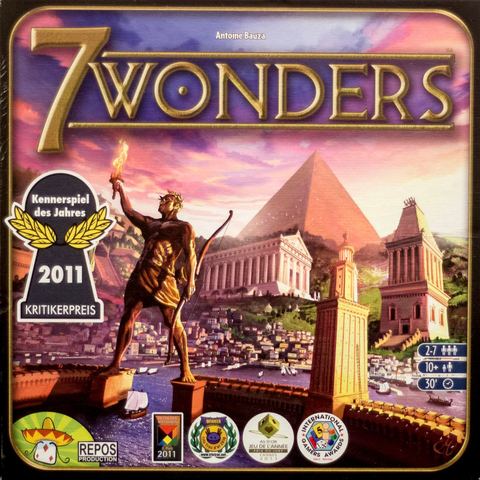
Is 7 Wonders worth buying?
Five reviewers converge on 7 Wonders' drafting and scalability, but split on interaction, long-term depth, and whether to buy the original or 7 Wonders Duel.
Search the full catalogueReview evidence
Accessed and checked individually- Official sourceRepos Production: 7 Wonders — Official Product Page
Accessed 23 September 2026
Antoine Bauza. Repos Production (Asmodee), 2010; 2020 New Edition added reference cards. Official 3–7 players, 30 min, age 10+. Inaugural Kennerspiel des Jahres 2011; 30+ awards. Does not count toward the five independent reviewer sources.
- Written reviewBoard Game Quest: 7 Wonders Review
Accessed 23 September 2026 · Independent group: Board Game Quest · Product access: not stated · disclosure not found
Tony Mastrangeli, September 2012. 5/5 stars, 'must own.' Site general disclaimer notes most reviews use publisher-provided copies; specific disclosure not stated for this review. Amazon affiliate links. Reviewer notes it is among their top five games despite rarely winning.
- Written reviewMeeple Mountain: 7 Wonders Game Review
Accessed 23 September 2026 · Independent group: Meeple Mountain · Product access: not stated · disclosure not found
Kurt Refling, August 2020. Played and taught hundreds of times at a board game café. Positive overall; describes the game as 'a pretty solitary experience' due to limited direct interaction. Notes 2020 New Edition improved icon accessibility. Amazon affiliate link; no specific disclosure found.
- Written reviewMeeple Like Us: 7 Wonders (2010)
Accessed 23 September 2026 · Independent group: Meeple Like Us · Product access: not stated · disclosure not found
Michael Heron, December 2018. Most critical: 'a good game that I don't think anyone needs to buy' given Duel and Sushi Go as alternatives. Notes seating arrangement affects win probability. Hobbyist Media Code of Ethics, £25 de minimis; Amazon affiliate links; no specific disclosure found.
- Written reviewBoard Game Reviews by Josh: 7 Wonders Review
Accessed 23 September 2026 · Independent group: Board Game Reviews by Josh · Product access: not stated · disclosure not found
Josh (blogger), October 2011. 8.5/10; describes 7 Wonders as 'a very good game' and 'a high-end filler' rather than a primary gaming choice. Notes limited decision variety emerging after many plays. Amazon Associates affiliate links; independent personal blog on Blogger; no commercial disclosure found.
- Written reviewIslay the Dragon: Review: 7 Wonders
Accessed 23 September 2026 · Independent group: Islay the Dragon · Product access: purchased · no commercial relationship stated
FarmerLenny and Futurewolfie, October 2011. 9.0/10 ('Very Good'). Explicitly purchased at Barnes & Noble. Describes the simultaneous format as 'nearly flawless execution' for minimising downtime. Both reviewers played extensively. Dual-perspective review with separate scores (9.5 and 8.5).
More guides
- Buying guideBoard games past the gateway stageSix board games for groups that have enjoyed Ticket to Ride or Catan and want more strategic depth. Player counts, teach times, and fit notes for each.
- ReviewsBlood Rage, according to the people who played itFive reviewers praise Blood Rage's miniatures and card-driven combat, but split on expansion pricing, a figurine design, and whether one card distorts the game.
- Table cultureThe rule you have been getting wrongHow common rule errors stay hidden in popular games, why they rarely surface until someone checks, and what to do when you find one mid-session.